
In the wake of Prince’s death, I’m seeing a lot of remembrances of his otherworldly instrumental talent, his incredible longevity and volume, his influence on popular music, and his amazing live performances. All those are features Prince possessed that are indeed worthy of significant praise. However, his most important quality was his resistance to the pull of expectations and easily sustained success. This is true of all great artists, from Mozart to Van Gogh to Miles Davis to David Foster Wallace; they break molds, obeying only a restless energy that demands constant invention in an attempt to capture and do justice to an endless font of creativity. Prince’s compositional inspirations are as broad as my listening inspirations, so he wrote songs of almost inexpressible breadth, and he never let the whims or expectations of the public, the record label, or the media dictate his next move. This was true in the beginning and remained true throughout his career.

Prince’s first album, For You, was put together when he was still a teenager. Nonetheless, he insisted on having production control in addition to playing all instruments and performing all vocals, a status which would be repeated on each of his first five albums and many subsequent albums1. Prince knew what he was and would not begin by compromising. The lead and title track of For You featured a dozen a cappella Princes harmonizing “All this and more is for you.” The album yielded a #12 R&B2 hit in Soft and Wet, while nothing charted on the Billboard Hot 100.

His second album, Prince, capitalized on this minor success with more strong R&B offerings including Prince’s first Hot 100 track, #11 I Wanna Be Your Lover (which also hit #1 R&B), plus the guitar driven funk of #13 R&B Why You Wanna Treat Me So Bad? and I Feel For You, which would hit #3 Hot 100 in 1984 for Chaka Khan with guests Stevie Wonder and Melle Mel. Beyond these and the classic piano-laden funk burner Sexy Dancer were country-tinged tracks like When We’re Dancing Close And Slow and It’s Gonna Be Lonely, plus the punkish les-bio Bambi. Prince’s self-determination and variety was already showing through for those who cared to look, while the strength of its hits gave him his first charting album at #22. Prince was 21 years old.
At this point, after two years, two albums, a strong R&B following and a minor incursion on the pop charts, Prince made for himself a crossroads. He recorded in his home studio a bunch of rough tracks that stylistically was more punk and new wave than standard R&B. The funk was still there in the yet-to-be classic Prince clean arrangements of guitar, bass, synths, and pristine drums. But the dominant tone was rock, so stripped down to be completely against the grain of bloated prog rock, disco, and AM soft-rock that dominated the airwaves in 1980; indeed, this sound’s closest analogs were punk and new wave, by far.
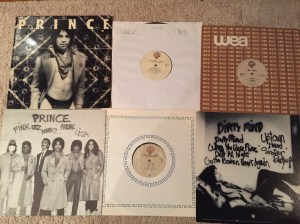
Prince’s unembellished home demos became the subsequent album, Dirty Mind, and although it produced no pop hits and only one R&B chart hit (Minneapolis ode Uptown), it did contain Head, a raunchy funk monster featuring nasty bass, chicken scratch guitar, and vicious synths. Lyrically, it was Head, Sister, and Do It All Night that showed how anti-radio Prince could get lyrically, stretching beyond the innuendo of Soft & Wet and I Wanna Be Your Lover (“I wanna be the only one you come for”). Dirty Mind was so bare, hot, and lascivious it had Mick Jagger and Andy Warhol tripping over themselves to catch Prince and his band at The Ritz hotel ballroom in mid-1981.
About that crossroads… While Dirty Mind was Prince’s first definitive statement that he was not beholden to routine or predictability, he was still producing songs that could burn up the funk scene; these were used to jumpstart the career of The Time, consisting of many of Prince’s longtime friends like Morris Day, Jimmy Jam (Harris) and Terry Lewis. The Time’s self-titled debut was the first of 8 complete albums Prince would produce for other artists between ’81 and ’85.

The album’s two top-ten R&B hits, Get It Up and Cool, were a monstrous hybrid of George Clinton’s brainchildren Parliament and Funkadelic, except here Prince was Bernie Worrell, Bootsy Collins, and everyone else all in one. Giant synth-dominated grooves with even bigger guitars and running times approaching and eclipsing ten minutes, these tracks along with Dirty Mind’s Uptown and Partyup (which Prince chose when invited to perform on SNL in 1981) were really the foundation of what would become the Minneapolis Sound, accessible to anyone who wanted to have an unpretentious good time. Prince gave all this to his friends3, and reserved his own album as a declaration of independence.
Prince retained this dichotomy—heavy funk for The Time, personal vision for self—on his next two offerings, his own Controversy in late 1981 and What Time Is It? for Morris and company in early 1982.
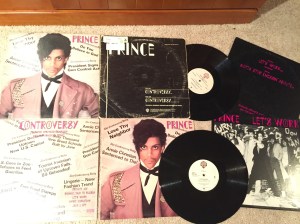
For Controversy, Prince extended the song lengths; top tracks Controversy and Do Me, Baby each ran past seven minutes. He also made things political, addressing sexuality , the Cold War, Christian hypocrisy, and um, masturbation (Jack U Off). This isn’t his strongest set of songs overall—the title track and Let’s Work managed to hit top 10 R&B while like its predecessor this album yielded no pop hits—but he made a tough blend of funk and rock while courting, yes, controversy with his unashamedly forward lyrics. Regardless of its quills, this was Prince’s second charting album, reaching #21 in November 1981.
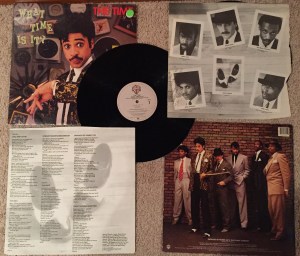
What Time Is It? was more straightforward: do you wanna get funked up? The album hit #26 on the Billboard charts. Its opener, Wild And Loose, plus two more top-10 R&B hits in 777-9311 and The Walk, were as funky as anything happening in 1982. In two albums Prince had given The Time an arsenal of songs that blew up black radio and resulted in crowds sometimes favoring Morris and his friends at shows co-billed with Prince in ’82-’83.
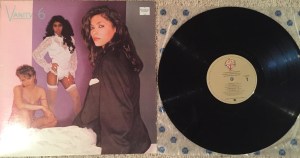
Also in 1982 Prince aimed to get into the girl-group game, but only on his own boundary-pushing terms. He formed a trio with frontwoman Vanity (Denise Matthews). These women would be sex objects, dressed in negligee, but the content of Vanity 6’s songs placed them firmly in control of their romantic destinies. In Nasty Girl, He’s So Dull, and If A Girl Answers (Don’t Hang Up), the ladies made clear what they wanted, what they didn’t want, and what they wouldn’t put up with, belying the giving-it-up wardrobe choices. The sounds on the album ranged from a sparser take on Time-styled funk (If A Girl Answers, Nasty Girl) to Go-Go’s-inspired new wave (He’s So Dull, Bite The Beat) to Devo-meets-George Clinton (Drive Me Wild, Make-Up). The lyrical content prevented this album and its songs from getting much radio or chart action, but Nasty Girl was huge in dance clubs. On its own merits, Vanity 6 is like nothing else.
Back to Prince’s own records, in 1982 he had moved on from Controversy, holing up with his Oberheim Synthesizer and Linn Drum to create the sprawling masterpiece 1999 double-album. Released in late 1982, this was Prince’s first album wherein the hits performed better on the Hot 100 than they did on the R&B chart; 1999, Little Red Corvette, and Delirious hit at 12, 6, and 8 respectively on the Hot 100 and just 4, 15, and 18 R&B. I find the album to be funkier than all of its predecessors, but it depends on what you call funk; my definition has always been skewed by Prince’s canon. Here Prince is coming so far into his own unique style and voice4 that he’s reached his hereafter permanent status: impossible to pigeonhole or classify.
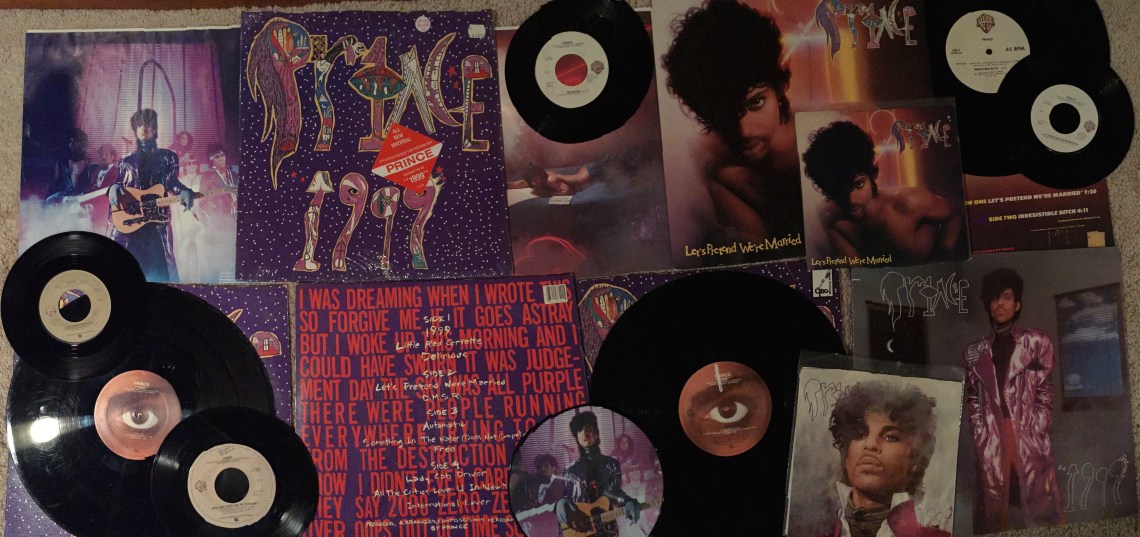
If you say this album is Something, it also contains a counterexample that proves it is Something Else. 1999 is funk that was cribbed by Phil Collins for Sussudio three years later; Delirious is shrill-synth rockabilly; Little Red Corvette is a rock staple, the woman-as-car metaphor wrapped in the silkiest synth groove; Let’s Pretend We’re Married is an urgent carnal plea that turns angry; DMSR is an eternal funk slammer that calls out our favorite elements; Automatic stutters its way to robot love that even the white folks called out in DMSR can get to; Something In The Water gives us a lover’s confusion over electronic Devo drums, angular synth lines, and anguished shrieks; Free is a political ballad; Lady Cab Driver changes up with acoustic drums and the funkiest guitar for eight minutes; All The Critics Love U In New York pokes fun at the turnabout between his Dirty Mind and Controversy albums; and International Lover won the Grammy for Best R&B Vocal Performance. This 80-minute album was the product of one person, master of guitar, bass, drums, synths, and surprise. It was Prince’s first top-10 album, reaching #9.
We’ll stop the chronology here, where these first five albums set up Prince’s global takeover of 1984. Including The Time and Vanity 6, he managed to write and self-produce eight albums in his first five years. From the very start, Prince showed that he would follow his own vision and not let chart hopes or label demands determine his output. He stripped down to fundaments and then built up the Minneapolis Sound from scratch. On his own terms, by 1982 Prince had already created songs and sounds unlike anything else. In my next post I’ll explore the years 1984 – 1988, wherein we received Purple Rain and Sign O The Times. For now, let’s listen to something. My 2003 debut turntable mix, The Funk, is full of Prince and Time tracks covered here: Head, DMSR, Get It Up, Cool, 777-9311. They are augmented by Funkadelic, Michael Jackson, Chaka Khan, Stevie Wonder, and others. Do yourself a favor and get with it:
If you want to get ahead of the narrative, check this out:
- While I’m not directly referring to or quoting it, much of my biographical knowledge of Prince comes from: Nilsen, Per. Dance Music Sex Romance: Prince: The First Decade. London: Firefly, 1999. Print. ↩
- All chart information is referenced from my library of indispensible Joel Whitburn books on Billboard history: Whitburn, Joel. The Billboard Book of Top 40 Hits. New York: Billboard, 2004. Print. Whitburn, Joel. The Billboard Book of Top 40 R&B and Hip-hop Hits. New York: Billboard, 2006. Print. Whitburn, Joel. The Billboard Book of Top 40 Albums. New York: Billboard Publications, 1995. Print. ↩
- Prince recorded these himself, drums, bass, synth, guitar, and a full vocal track. Morris Day simply replaced Prince’s scratch vocals, still audible in the background if you listen closely. ↩
- Voice indeed, as his first four albums had only one non-falsetto song, while 1999 is predominantly in his natural register. ↩

 djhighlifemixes